
Two Giants Just Rewired the CRM — and the Entire MarTech Conversation
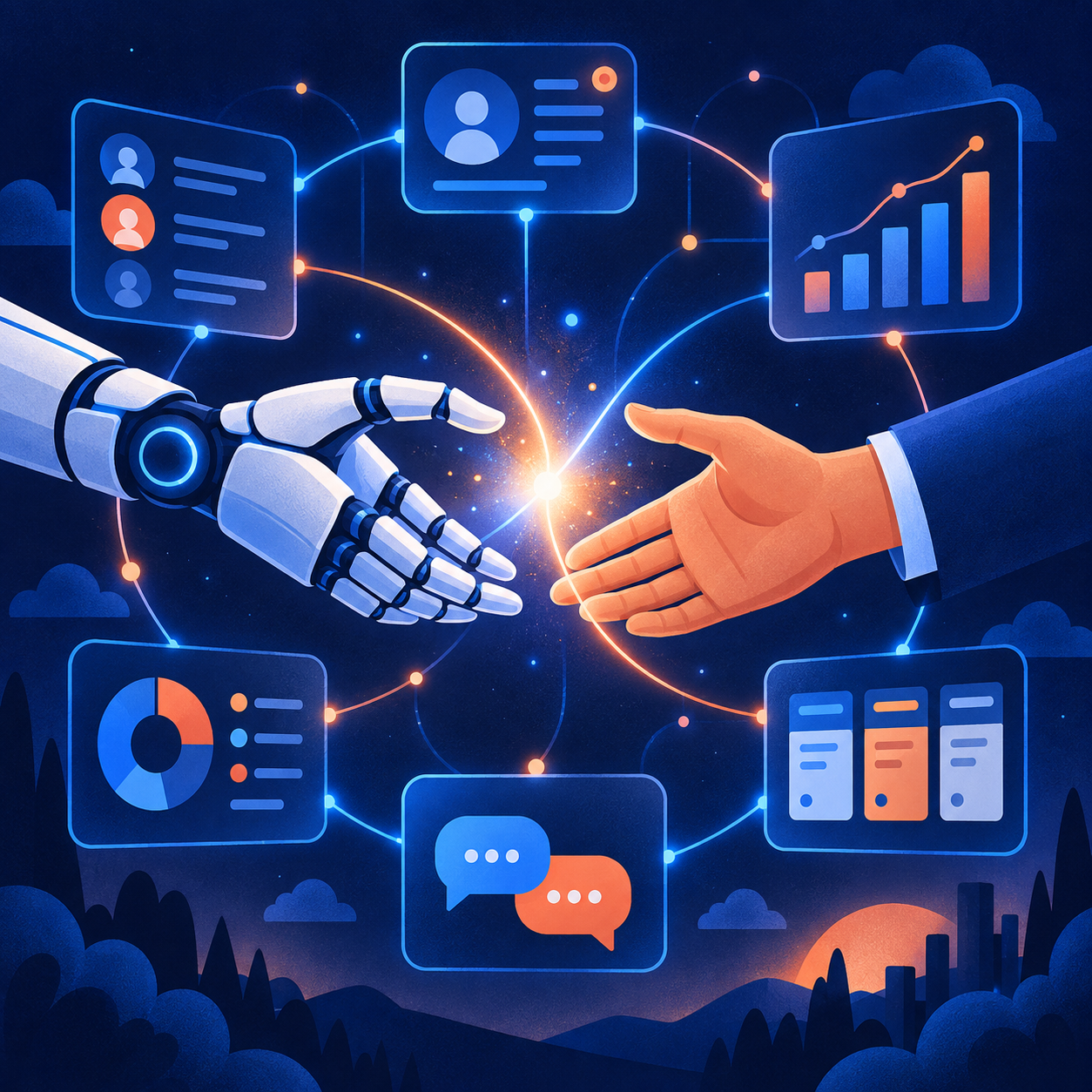
On August 26, 2026, Salesforce and Anthropic announced Claudeforce — an integration that puts the entire Salesforce CRM inside Claude, turning the world’s most popular AI assistant into a full CRM cockpit. Marc Benioff framed it as the answer to the “SaaSpocalypse”: instead of logging into a dozen screens, marketers and sales teams ask an agent to do the work. Within days, early adopters reported running Salesforce headless — no app, no navigation, just a conversation with their data.
This is not a product launch. It is the clearest signal yet that agentic AI is dismantling the martech stack as we know it — and marketers need a new operating model, fast.
Peak MarTech: 15,505 Tools and Nearly Zero Growth
The context makes the shift inevitable. Scott Brinker and Frans Riemersma’s 2026 Marketing Technology Landscape Supergraphic landed in May with a striking milestone: 15,505 tools, almost zero growth — the first plateau in the landscape’s two-decade expansion. Venture funding into standalone point solutions has cooled, platform consolidation is accelerating, and the analysts’ verdict is blunt: the era of “buy another best-of-breed tool” is over.
What replaces it? Brinker’s own analysis points to three forces: stacks flattening into fewer platforms, SaaS devolving into infrastructure, and AI agents taking over the decision layer — the very layer where marketers used to spend their days clicking.
What Claudeforce Actually Changes
Under the Claudeforce model, the CRM’s user interface is no longer the product. The product is an agent that can:
- Query and update records conversationally — pipeline, opportunities, account history — without opening Salesforce once.
- Execute workflows — nurture sequences, lead routing, follow-up cadences — that previously required admin configuration or third-party automation layers.
- Reason across Slack, Claude and CRM — Salesforce explicitly designed AIforce to bring CRM workflows into Claude, Slack and other AI interfaces, not just its own apps.
- Hand off to humans with context — the agent knows what it did, why, and what it recommends next, so marketers keep strategic control.
Forrester’s September brief on AI agents for marketing is blunt about the consequence: the CMO’s job stops being “orchestrating tools” and becomes “orchestrating agents” — defining outcomes, setting guardrails, and measuring what the agents produce.
What This Means for Your Stack
If agents become the primary interface to your marketing systems, three things change immediately:
1. Data quality becomes a board-level issue
An agent is only as good as the records it reads. Duplicated accounts, stale leads and mixed taxonomies — cosmetic problems in a click-driven world — become hallucination risks in an agent-driven one. Before you deploy any agent, audit your CRM hygiene and your data governance. This is the single highest-leverage preparation step.
2. Workflows shift from screens to intents
Instead of building a journey in a visual editor, you will describe the outcome to an agent: “Qualify every inbound lead within 4 hours, route tier-1 accounts to the sales team, and report anomalies daily.” The skills you need are prompt architecture, evaluation and exception handling — not button configuration.
3. Governance becomes your competitive moat
Forbes asked CMOs to question how AI agents make decisions — a fair concern, since agents that operate autonomously inherit every bias and blind spot in your data. Marketers who invest in observability (what did the agent do?), approval gates (what must a human sign off?) and audit trails will win trust with their boards — and their customers.
Key Takeaways
- The UI is dying, the data survives. Agentic AI makes your CRM, CDP and analytics layers the true product; the interface becomes a conversation.
- Peak martech is real. Stop buying tools; start consolidating platforms and cleaning data.
- Agents change the CMO’s job. Strategy, evaluation and governance matter more than tool orchestration.
- Start with one bounded workflow. Pick a repeatable, measurable process — lead qualification, campaign reporting, content briefs — and run it through an agent before scaling.
Claudeforce is the opening shot, not the final battle. The martech stack of 2027 will be fewer platforms, connected data, and an army of well-governed agents doing the clicking — so marketers can do the thinking.
For any questions or further clarifications, feel free to reach out at [email protected].
Sources: Salesforce/Anthropic Claudeforce announcement (Aug 2026); VentureBeat; CNBC; Forrester “AI Agents For Marketing Are Here” (Sep 2026); Scott Brinker & Frans Riemersma 2026 Martech Landscape Supergraphic (May 2026); CMSWire “Peak Martech: 15,505 Tools”.